

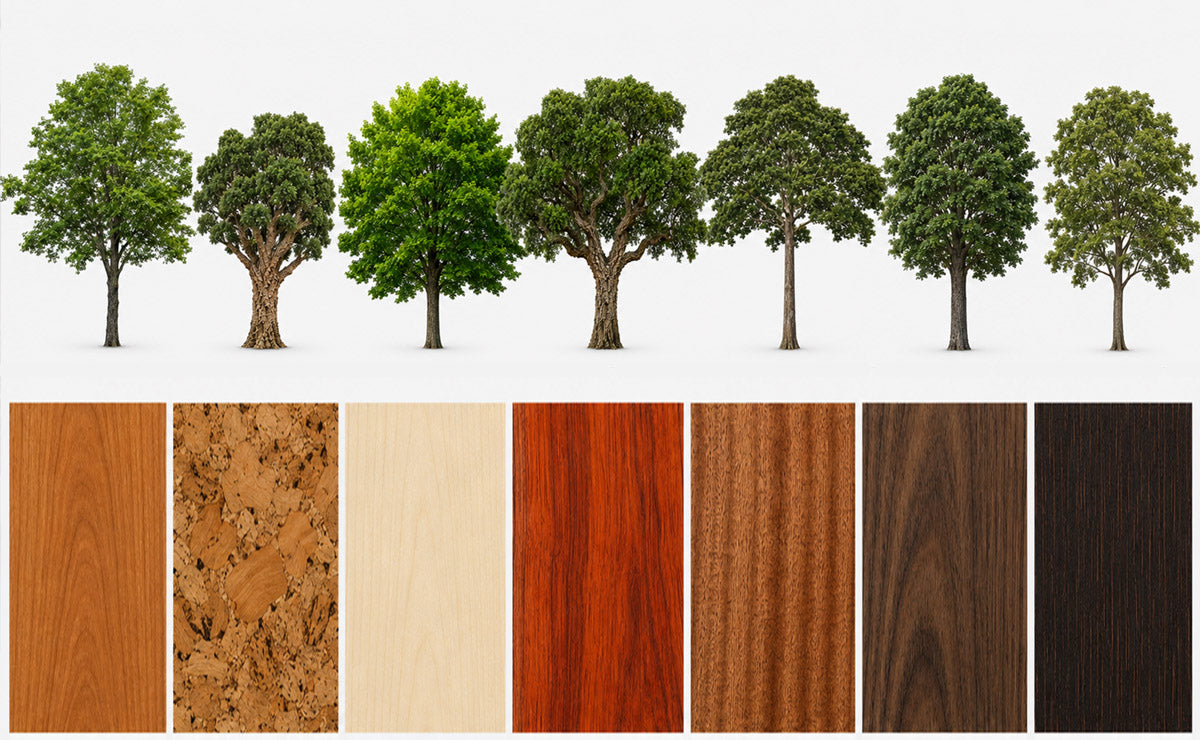
Veneer lets a small volume of wood cover an extraordinary amount of surface. Our wood veneers are sliced to roughly half a millimeter thick, delivering the natural color and grain of real wood while using significantly less material than a thicker solid-wood component would. Each case consumes about 0.15 square feet of veneer, cutting waste included, so one square foot of veneer becomes roughly six to seven finished cases.
That material efficiency is why we build with veneer. Some of the species on this list are especially valuable, and using them as thin visible layers preserves their natural character while limiting how much wood each case consumes.
These are the seven trees that end up in your pocket, where each one grows, and what gives each material its distinctive appearance.
The North American hardwoods
Three of the species we use are native to the hardwood forests of eastern North America, a range that includes parts of southern Ontario, not far from where we build the cases.


Hard Maple (Acer saccharum)
Grows: Northeastern North America, including southern Ontario · Color: pale cream with a soft satin sheen · Hardness: ~1,450 lbf Janka
Janka figures throughout are approximate values for solid wood; they vary naturally between trees and describe the raw material, not the finished case.
You already know this tree even if you've never worked with the wood: it's the sugar maple, the species most closely associated with maple syrup and one of the inspirations behind the stylized leaf on the Canadian flag. It's also among the harder widely used North American hardwoods, commonly chosen for basketball courts, bowling lanes, and butcher blocks. The wood is so uniformly pale and fine-grained that it almost reads as porcelain until the light catches the subtle figure in it.
On a case, maple is the clean canvas. Its consistency is exactly why we use it where precision matters and where a print or inlay needs a quiet background.
See maple on a case: Bloom, Cellular, and Beam.


American Black Cherry (Prunus serotina)
Grows: Eastern North America · Color: light salmon pink that deepens with light and age · Hardness: ~950 lbf Janka
Cherry is the wood that refuses to stay the same. Freshly cut, it's a pale pinkish tan. With light exposure it tends to deepen toward the warm reddish brown that furniture makers have long prized. That darkening isn't damage, it's the wood's signature move, and it means a cherry case may develop a deeper, richer color over its first year depending on how much light it sees. The tree itself is generous beyond its lumber: its small black cherries feed many bird and mammal species across its range.
See cherry on a case: Silver Fox, Flora, and Sakura.


American Black Walnut (Juglans nigra)
Grows: Eastern North America, up into southern Ontario · Color: chocolate brown, from milk to dark · Hardness: ~1,010 lbf Janka
Walnut is the aristocrat of North American hardwoods. Premium logs can be valuable enough that the theft of standing walnut trees is a documented problem in parts of its range. It offers an unusual combination of naturally dark color, good workability, and a native North American range. Those qualities have long made it a favored wood for fine furniture and gunstocks. It has a quieter distinction too: black walnut contains a compound called juglone in its roots and husks, and some plants growing within its root zone are notably sensitive to it, which is why gardeners plan around these trees.
Walnut is the backbone of our lineup, and if you only ever own one wood case, this is the one we'd hand you.
See walnut on a case: Walnut Rift, Walnut Pure, and Blossom.
The African hardwoods
The next three species are native to the tropical forests of West and Central Africa. They're some of the most distinctive timbers we work with, and veneer lets a relatively small volume of that wood provide the visible surface for far more cases than a thicker solid-wood component would.


Sapele (Entandrophragma cylindricum)
Grows: West and Central Africa · Color: golden to reddish brown with a ribbon shimmer · Hardness: ~1,360 lbf Janka
Sapele is a giant, one of the tallest trees in the African rainforest canopy, and it belongs to the mahogany family, which tells you most of what you need to know about its reputation. Its defining trait is interlocked grain: the fibers spiral in alternating directions as the tree grows, and when the wood is quarter-sliced, that interlocking produces a shimmering ribbon figure. Sapele is also widely used for guitar backs and sides. On a phone case, its appeal is visual and tactile: the ribbon figure shifts with the light and is more striking in hand than any flat photograph can show.
See sapele on a case: Summit, Canyon, and Puzzle.


African Padauk (Pterocarpus soyauxii)
Grows: Nigeria through western Central Africa · Color: vivid orange-red, darkening toward reddish or russet brown · Hardness: ~1,970 lbf Janka
Nothing else in the workshop looks like African padauk. Freshly cut, it's an almost implausible orange-red, so saturated that people assume it's stained. It isn't; that's just the tree. It's also one of the hardest woods we use, and when we cut it, the dust comes off the blade a bright brick red. Like cherry, it changes with light, typically darkening over time from bright orange toward a deeper reddish or russet brown.
See African padauk on a case: Argyle, Cross Country, and Strata.


Wenge (Millettia laurentii)
Grows: Central Africa · Color: deep chocolate to near-black with fine dark striping · Hardness: ~1,930 lbf Janka
Wenge is the darkest wood in our lineup and one of the most distinctive anywhere: chocolate brown so deep it approaches black, banded with fine, almost pinstripe grain. Its hardness and texture have made it a popular choice for bass fingerboards and other instrument components. It's also one of the higher-value veneers we buy, so using it as a thin surface layer preserves its visual impact while limiting how much of it each case consumes.
See wenge on a case: Kraken 2, Alium, and Restore.
The one we harvest without cutting down


Cork Oak (Quercus suber)
Grows: Western and central Mediterranean, including Portugal, Spain, and North Africa · Color: honey and caramel mosaic, no two sheets alike · Hardness: not directly comparable to solid wood
One honest clarification first: cork isn't technically wood. It's the bark of the cork oak, and that difference is the whole story, because the tree survives the harvest. Cork is stripped by hand roughly every nine years in a skilled practice that goes back centuries, and the bark gradually regenerates for a later harvest. A single cork oak can live for well over a century and be harvested many times across its life, supporting long-established Mediterranean agroforestry landscapes along the way. The material itself is soft, grippy, light, and naturally water-resistant (resistant, not waterproof), and every sheet is a one-of-a-kind mosaic.
If the rest of this article is about using valuable wood efficiently, cork goes one better: it's a material you can take from a tree, again and again, without felling the tree.
See cork on a case: Gold Cork, Quartz Cork, and Python Cork.
Why veneer is the whole point
Every case featured here starts with a precision-cut natural surface layer, wood veneer or cork, bonded to the case shell. Some of our designs showcase a single species edge to edge; others assemble several of these woods into one composition, walnut against maple against African padauk, using the natural colors instead of stains.
People sometimes ask why we don't machine cases from solid blocks of these woods. For the construction we use, veneer offers several practical advantages in a pocket. It helps keep the case thin and light, and bonding it to a stable shell limits the noticeable seasonal movement that can affect thicker pieces of solid wood. It also uses much less material while still putting the wood's natural color and grain at the visible surface.
Veneer lets us put real wood where it matters while using far less of it in each case. That balance of appearance, stability, and material efficiency is why we build our wood cases this way.
Ready to pick a wood of your own? Shop all of our iPhone cases, read our honest guide to the best wood phone cases, or see how our wooden phone cases are made.

Leave a comment
All comments are moderated before being published.
This site is protected by hCaptcha and the hCaptcha Privacy Policy and Terms of Service apply.