

How Our Wood Phone Cases Are Made: Inside the Keyway Workshop
Every Keyway phone case starts as raw sheets of real wood and ends up as something you can feel the difference of the moment you pick it up. We've been building them by hand at our workshop since 2012. Over 115,000 customers and thirteen years later, the process hasn't changed as much as you'd think.
Here's how we actually make them.

We work with six species for our wooden phone cases: wenge, walnut, maple, cherry, sapele, and padauk. Each one has a different grain pattern, colour, weight, and feel. That's the beauty. Walnut is dark and rich with a fine, flowing grain. Maple is pale and tight-grained, which makes it ideal for detailed inlay work where contrast matters. Wenge is almost black with coarse, dramatic striping. Padauk starts out a vivid reddish-orange and darkens naturally over time. Sapele has an interlocking grain that catches light differently depending on the angle. Cherry is warm and honey-toned, and like padauk, its colour deepens with age and exposure to light.
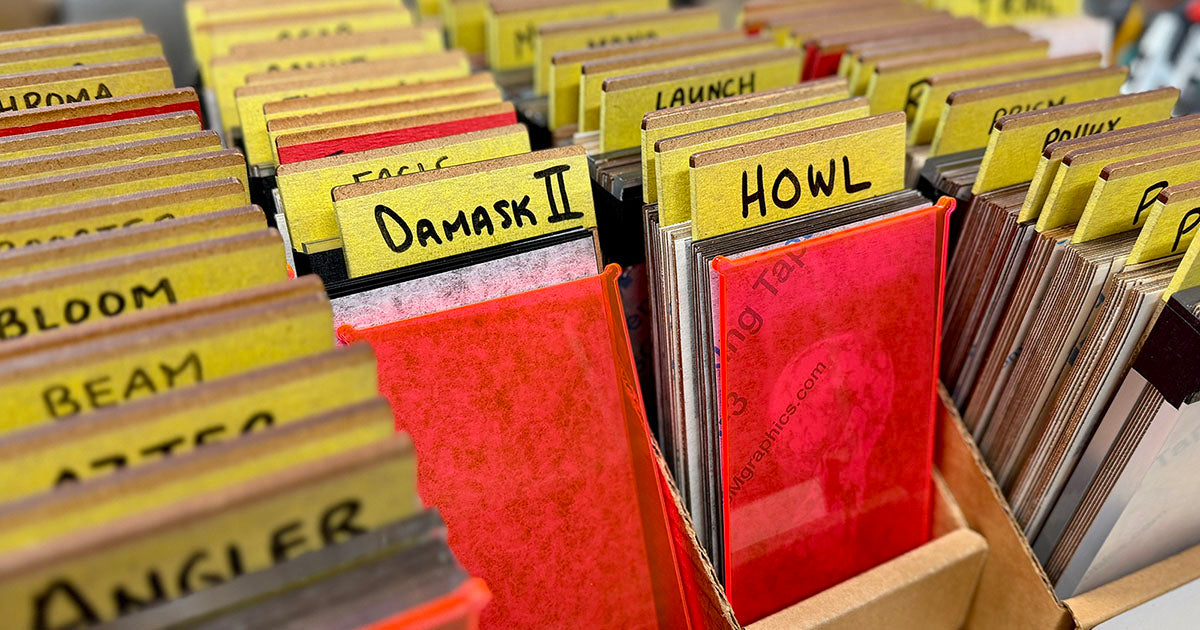
The wood arrives as reinforced veneer sheets, roughly 1/32" thick, with a semi-flexible backing that lets us work with it on a flexible phone case surface without cracking or splitting. Every sheet has its own unique grain, which means every case we cut from it is a little different. Even two cases of the same design, cut from the same species, will never look identical.


Our designs are cut on a Trotec laser cutter. For single-species designs, this is straightforward: the veneer gets cut to the profile of the case and it's ready for assembly. But the multi-wood inlay designs are where things get interesting.
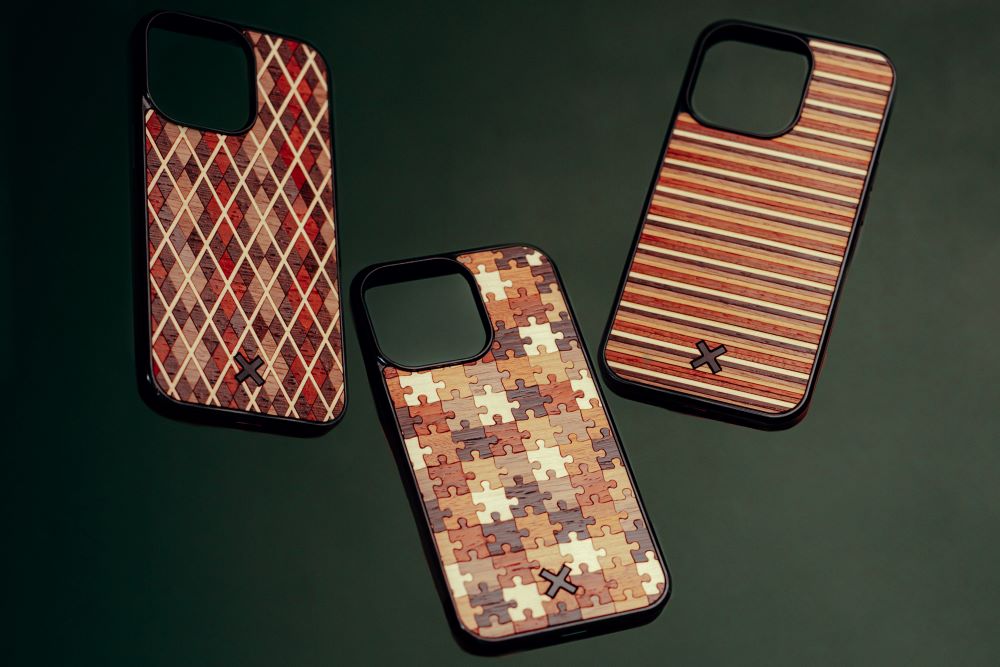
A design like our Explore or Cross Country case uses two or more different wood species interlocked together. Each piece is laser-cut separately from its own species sheet, and the pieces are assembled by hand onto a rectangle of adhesive backing, fitted together like a jigsaw puzzle. The tolerances here are tight. Every cut path in the laser file includes kerf compensation dialed to within 0.05mm to make sure the pieces fit together with no visible gaps. If the kerf offset is even slightly off, you get either gaps between pieces or pieces that won't physically fit together.
Once the inlay design is assembled onto the adhesive rectangle, the whole assembly goes back into the laser for a second cut, this time to the exact profile of the phone case shell. We don't cut to the final case shape until an order comes in, because each phone model has a different shell profile. That two-stage process (assemble the design oversized, then precision-cut to the exact case shape) is what gives us the flexibility to offer dozens of designs across dozens of phone models without pre-cutting thousands of inventory pieces.
The laser work also demands proper fume extraction and particulate filtering. Different wood species produce different compounds when they burn, and some of them aren't things you want in the air. We run a dedicated extraction system that filters particulate matter before exhausting, which keeps both the air quality and the cut quality consistent. Smoke residue on the wood surface will affect how the finish appears, so we remove what we can at the source and handle the rest with the final cleaning.


Our One & Only (O&O) line takes a completely different path. Instead of laser-cut veneer, O&O cases start as solid blocks of pure resin or resin and wood, cast from scratch in our workshop.
The process begins with custom molds and a casting resin formulated specifically for thick pours, the kind of deep casting that most standard resins can't handle without overheating or cracking. We combine the resin with mica pigments (we use Beaver Dust pigments) and real wood to create blocks where the resin and wood flow into each other. The colours, patterns, and boundaries between wood and resin are never the same twice. Each block is poured under carefully dialed-in pressure and timing conditions that took us a long time to perfect. This is one of the parts of the process where the work of trial and error really show.
Once a block is fully cured, it moves to our slicing station. We designed and built a custom slicing machine in-house that cuts each block into thin, consistent slices on a bandsaw. The machine was purpose-built to maximize the number of usable slices from each block while keeping every slice uniform in thickness. Getting maximum yield from each cast block matters. The casting and curing process takes days per block, so every wasted slice is real lost production time.
Each slice becomes the back of a single phone case. Every one gets a sequential O&O number, a permanent record of when it was made and where it sits in the history of the line.


Every case, whether it's a laser-cut wood inlay or an O&O resin slice, goes through sanding and finishing before assembly.
We designed and built custom vacuum hold-down jigs for sanding. The jigs grip each piece precisely so it stays perfectly flat and stationary during sanding, which is what gives us a consistent surface across the entire face of the case. Without the hold-down, the thin veneer or resin piece would flex under sanding pressure and you'd get uneven spots, thickness variations that show up as differently textured patches once the finish goes on.
After sanding, each piece gets a UV-cured protective clear coat. UV curing, as opposed to air-drying or heat-curing, gives us a harder, more scratch-resistant surface in a fraction of the time. We run the coated pieces through a UV curing oven that we also designed and built in-house. The oven uses calibrated UV output to ensure the coating cures evenly and completely across the entire surface, which is what gives the finished wood and resin its depth and clarity.


The finished wood or resin backer gets mounted onto a flexible TPU rubber shell using pressure-activated adhesive. The adhesive bonds under force, so each case gets pressed together in a 3-ton manual press to set it. It's the precision of the laser-cut fit, the backer sitting flush with the edges of the TPU frame, that finishes the look. When the cut is right, the transition from wood to rubber is seamless.
The shells themselves are 1.3mm flexible rubber with full wrap-around protection: raised lip above the screen, camera cutout protection, covered buttons, and on newer iPhone and Galaxy models, integrated MagSafe-compatible magnets. Every case works with wireless Qi chargers.

Before anything ships, every case gets a final inspection. We're checking for blemishes on the TPU frame, pits or knots in the wood veneer that don't look right, smooth and consistent finish on the wood surface, no warping or cracks, and tight consistent fit of laser-cut inlays. For our leather cases, we allow some natural marks. That's a hallmark of full-grain vegetable-tanned leather and part of what makes it genuine, but anything that looks like a defect rather than a natural characteristic gets pulled.
For O&O cases, the QC pass adds checks for sanding consistency and finish uniformity across the resin surface, since resin shows imperfections more readily than wood grain does.
Anything that doesn't pass gets pulled from the line. We'd rather eat the cost of a rejected piece than ship something that doesn't feel right in your hand.


We've spent thirteen years building and refining custom equipment for this process: the slicing machine, the vacuum sanding jigs, the UV curing oven, the laser workflow. None of this is off-the-shelf, and most of it went through multiple iterations before it worked the way we needed it to. You won't see any of that in the finished product. What you'll feel is what it produces: a case that sits flat, fits flush, with a beautiful surface you actually want to touch.
Every Keyway case is made to order at our workshop in Mississauga, Ontario, backed by a 1-year warranty and a 30-day satisfaction guarantee. We've been doing this since 2012 and we have no plans to stop.


Leave a comment
All comments are moderated before being published.
This site is protected by hCaptcha and the hCaptcha Privacy Policy and Terms of Service apply.